
Michelin-starred chef to spearhead culinary operations and new restaurant at The Inns at St. Albans
Accomplished chef Chris Anderson, who earned his Michelin star at Moto in Chicago, will lead a team that arrives in June.
By George Mahe
See original article as it appeared in St. Louis Magazine here.

Chef Chris Anderson
One of the region’s most enchanting event destinations is poised for a major culinary evolution.
A three-chef team will soon take over culinary operations at The Inns at St. Albans, with accomplished chef Christopher Anderson at the helm. Anderson trained at the two-Michelin-starred Auberge de L’Ile in France and later earned his own Michelin star while serving as executive chef at Chicago’s Moto. His background also includes stints at celebrated restaurants including Alinea, L2O, and Restaurant R’evolution in New Orleans. The move coincides with Anderson’s newly formed company, Anderson Culinary Innovations (ACI), and a long-term agreement to oversee food and beverage operations throughout the St. Albans property.
“With chef Anderson’s arrival, we continue to grow and elevate the level of service we offer our corporate and wedding clients, overnight guests and daily visitors,” says Datra Herzog, owner of The Inns at St. Albans. “This is a thrilling new chapter in our beloved destination’s story.”
The Complex
The long-term vision includes the anticipated spring 2027 reopening of the historic Old Barn Inn Restaurant, which many longtime diners may remember as Malmaison, one of the region’s earliest true country French restaurants. The fine-dining space will be renamed and led by Anderson personally. The restaurant is expected to seat approximately 35–40 guests and will likely feature an approachable tasting menu format alongside an à la carte option for diners seeking a more casual experience.


The Château pavilion and gardens at The Inns at St. Albans
The culinary team will oversee operations throughout the sprawling property, including Mabel Mae’s at Head’s Store, the Head’s Store Rock Island Room, former Old Barn Inn and Pavilion, The Chateau, The Lodge Meeting Room, all in-room dining and cottage foodservice, as well as on- and off-site catering and beverage operations.

Tavern Creek Tavern at The Inns at St. Albans

Cottage at The Inns at St. Albans

The Lodge at The Inns at St. Albans

Studio Hill Vineyard at The Inns at St. Albans
Anderson says he has long admired destination hospitality properties including Blackberry Farm—the farm, restaurant, and inn in Walland, Tennessee—as well as SingleThread, the similarly themed, three-Michelin star rated complex in Healdsburg, California.
“Datra has a similar vision for the St. Albans property,” Anderson says. “The facility and buildings are versatile and have good bones. We hope we can create a little of the same magic here.”
The Food
Chef Hayden Jones arrived in April, while the remainder of the team is expected to relocate from New Orleans in June.
After receiving the call from Anderson, Jones arrived early to relaunch Mabel Mae’s at Head’s Store in April. The historic space now features Southern-inspired breakfast and lunch offerings including brisket biscuits, spicy fried chicken, barbecue, and short rib sandwiches. Anderson says the next phase will further develop Head’s Store into a true modern general store, complete with house-made sauces, rubs, pickled vegetables, smoked bacon, garden products, and potentially a cut-to-order butcher counter and hearth oven.
“We want to give people another reason to pay a visit,” Anderson says. “You can have lunch, buy ingredients, and go home with what you need to make a great meal.”
Anderson, who grew up in North Carolina, and Jones, a Texas native, both share deep barbecue traditions. But Anderson says the restaurant’s larger mission is to reinterpret American cuisine through a refined farm-to-table approach. Plans include growing vegetables both on the property and atop the restaurant’s fortified rooftop.


He points to the influence of Native American, French, Spanish, German, English, African, and Italian culinary traditions—the “seven nations” often credited with shaping Cajun and Creole cuisine—as inspiration for what he calls a “what makes us ‘us’” approach to American food. “The American South created its own culinary identity,” Anderson says. “St. Louis has a lot of those influences too, so it’s not a stretch to focus on this type of cuisine.”
Rather than replicate classic dishes outright, Anderson encourages his team to reinterpret familiar flavors in unexpected ways. At Restaurant R’evolution, for example, he served oysters three different ways and transformed a Louisiana seafood boil into a composed fine-dining dish featuring crawfish broth gelée formed into a cannoli-like wrapper, stuffed with corn mousse, shrimp, crawfish, and potato purée.


The Vineyard Dinners
As a “first taste” of the direction that the culinary program is heading, the property has announced Studio Hill Vineyard Dinners at The Chateau (formerly The Studio Inn) on June 27, July 18, August 15, September 12, and October 24. Tickets for the first dinner, available here, are $125 for the four-course meal, plus $50 for curated wine pairings, and 15 percent off lodging for the night. The June menu is as follows:
- Amuse Bouche
- First Course: Summer Vegetables, chive oil, Meyer lemon
- Second Course: Seared Sea Bass with heirloom tomatoes, shallot Beurre Blanc
- Third Course: Corn Husk Smoked Duck with charred onion, Guajillo chili
- Dessert Course: White Peach Panna Cotta with bourbon and vanilla
- Mignardise
The Team
Anderson’s core team consists of chefs he has worked alongside for years in New Orleans who are relocating as part of the project:
- Jones, formerly Anderson’s sous chef at Restaurant R’evolution, oversees Head’s Store.
- Executive sous chef Jack Dennis, who worked with Anderson for six years, will direct banquets and catering operations across the property.
“Each one has their own operation to run,” Anderson says. “Each one leads their own parade.”
The partnership came together through hotel executive Nathan Nichols, founder and CEO of Storie Co., who previously worked with Anderson on hospitality projects in California, Palm Springs, Nashville, and Washington, D.C. Nichols later introduced Anderson to Herzog and encouraged a partnership structure in which Anderson Culinary Innovations would independently operate the property’s food and beverage program. Under the agreement, ACI oversees all culinary operations, staffing, and liquor licensing throughout the complex.
Anderson’s Background
Born and raised in Washington, North Carolina, Anderson attended the International Culinary School at The Art Institute in Charlotte, where he earned a silver medal in the American Culinary Federation Junior Hot Foods Competition. In 2010, he moved to France for an intensive immersion program in Cap d’Agde before being placed at Auberge de L’Ile, the two-Michelin-starred restaurant where he lived above the kitchen and trained under chef Jean-Christophe Ansanay-Alex for nine months. Under Ansanay-Alex’s mentorship, Anderson says he learned the importance of precision, discipline, and emotional connection in hospitality—lessons that permanently shaped his expectations for restaurant culture.
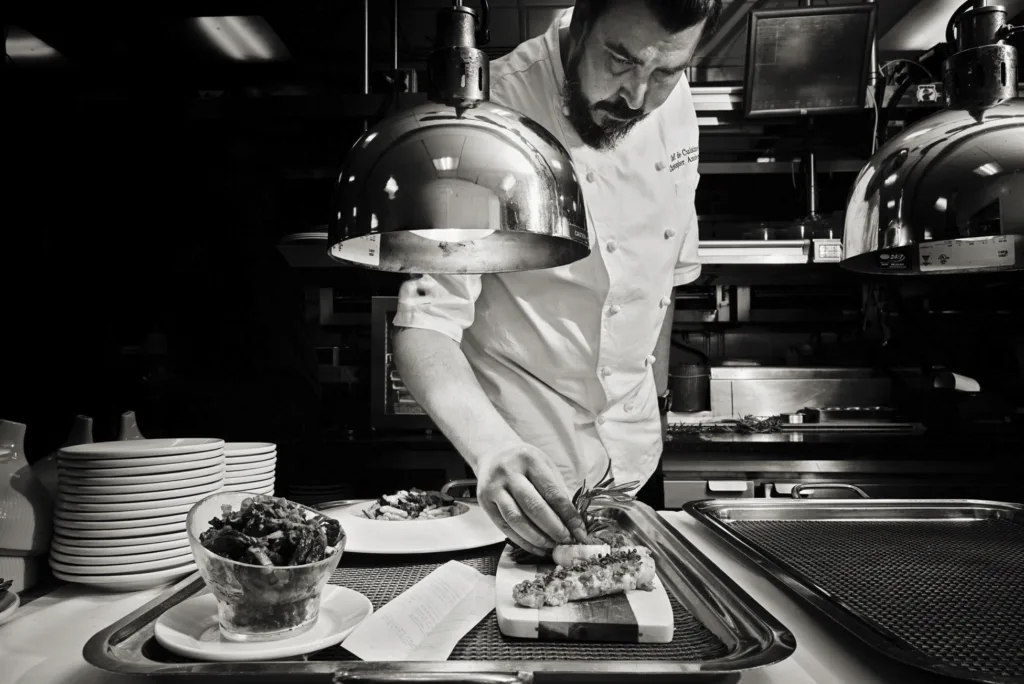
“I got used to the Michelin-star level of food and service—the level of detail and the drive that everyone possessed,” Anderson says. “I didn’t want to go back to anything less than that.”
After returning to the United States, Anderson staged at Le Bernardin before accepting a position at Alinea. He later worked at the three-Michelin-starred L2O before eventually finding his culinary home at Moto. At the time, Moto and Alinea were at the forefront of Chicago’s molecular gastronomy movement. Following the death of Moto chef-owner Homaro Cantu in 2015, Anderson was promoted to executive chef and tasked with maintaining the restaurant’s Michelin star. Rather than preserve the existing menu—which he was encouraged to do to preserve Cantu’s star—he completely rewrote it within a month, shifting the cuisine toward a more personal, Southern-inspired direction. Nine months later, Michelin returned and awarded the restaurant a star under Anderson’s leadership.
Following Moto’s closure, Anderson moved into consulting and hotel projects before eventually settling in New Orleans, where he became chef de cuisine at Restaurant R’evolution at The Royal Sonesta New Orleans. There, he worked alongside celebrated chef John Folse (a.k.a. “Louisiana’s Culinary Ambassador to the World”), known for modernizing and elevating Cajun and Creole cuisine while championing the culinary traditions of the region.
Now, after a 20-year culinary journey that has taken him from Michelin-starred kitchens in France and Chicago to luxury hotels and celebrated restaurants across the South, Anderson says he’s finally found the right diamond-in-the-rough opportunity to build something of his own.
“I didn’t want to move anywhere else unless I owned whatever I was getting into,” he says.